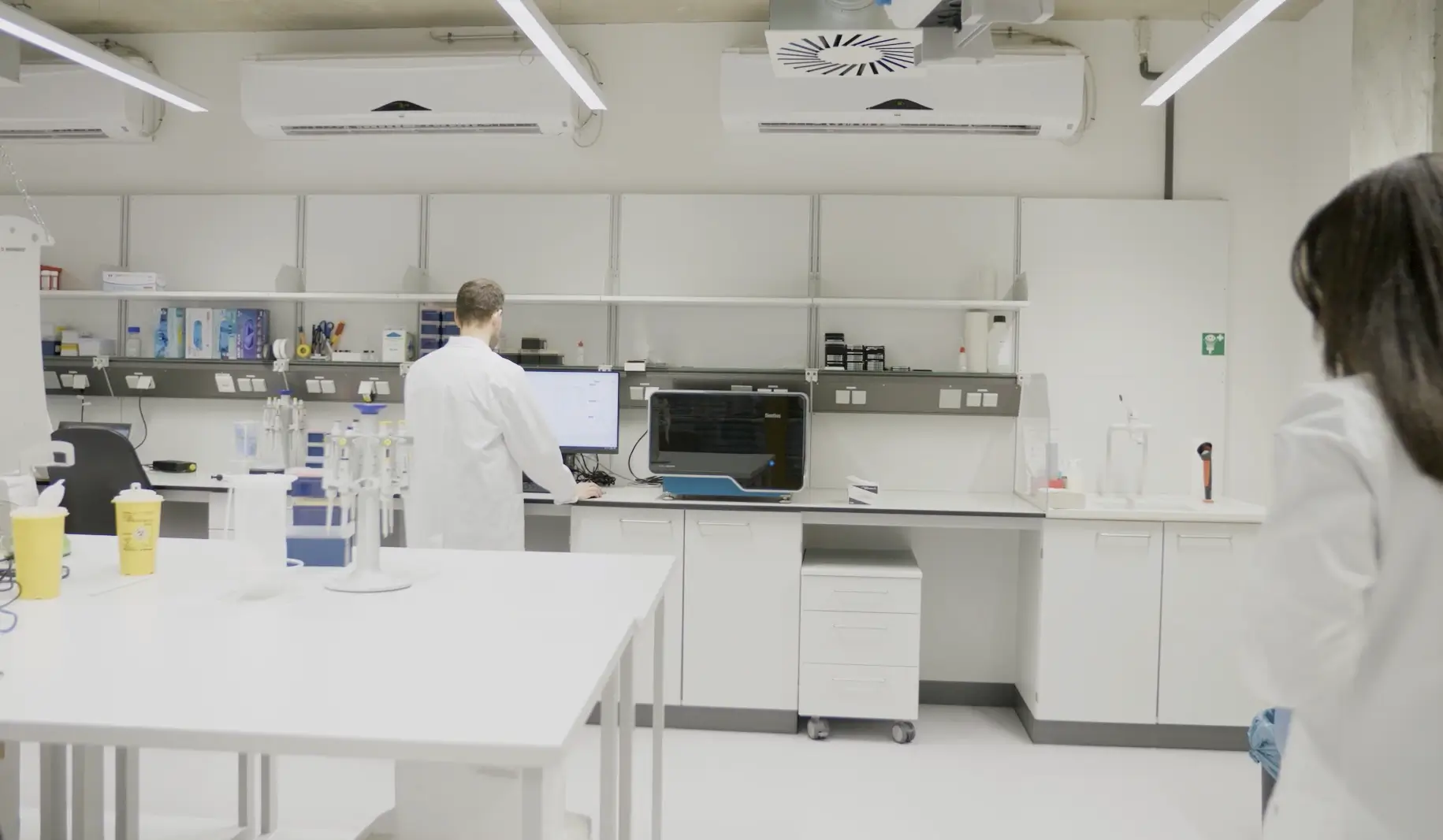
Dianthus

Tough targets.
Confident decisions.

Dianthus

High-quality binding affinity data from challenging samples. Screen and validate hundreds of compounds with the sensitivity to find true binders, and the confidence to move forward faster.


Group 1618867111

Higher sensitivity. Better decisions. 

Get binding data fast.

Higher sensitivity. Better decisions. 

Get binding data fast.

Get binding data fast.

Screen thousands of fragments in an afternoon or generate 24 dose-response curves half an hour. Work with minimal sample volumes and detect binding at picomolar concentrations. 
Work with the samples you have, not the ones you wish you had.

Work with the samples you have, not the ones you wish you had.

High signal-to-noise ratios cut through aggregates and contaminants, delivering clean binding curves even when prep quality isn't perfect. Identify aggregation and folding issues early with reliable in-solution data, even from fragile targets like membrane proteins. 
Spend time on real hits, not false positives.

Spend time on real hits, not false positives.

Two complementary in-solution readouts (Spectral Shift and TRIC) help you confirm true binders and rule out artifacts. 384-well plates integrate seamlessly with your existing automation for high-throughput workflows.
Take your analysis further with structured, AI-ready data exports.

Take your analysis further with structured, AI-ready data exports.

Human and machine readable .json file formats allow for rapid integration into your analysis pipeline, whether that's NanoTemper software, alternative vendors, or open source options.
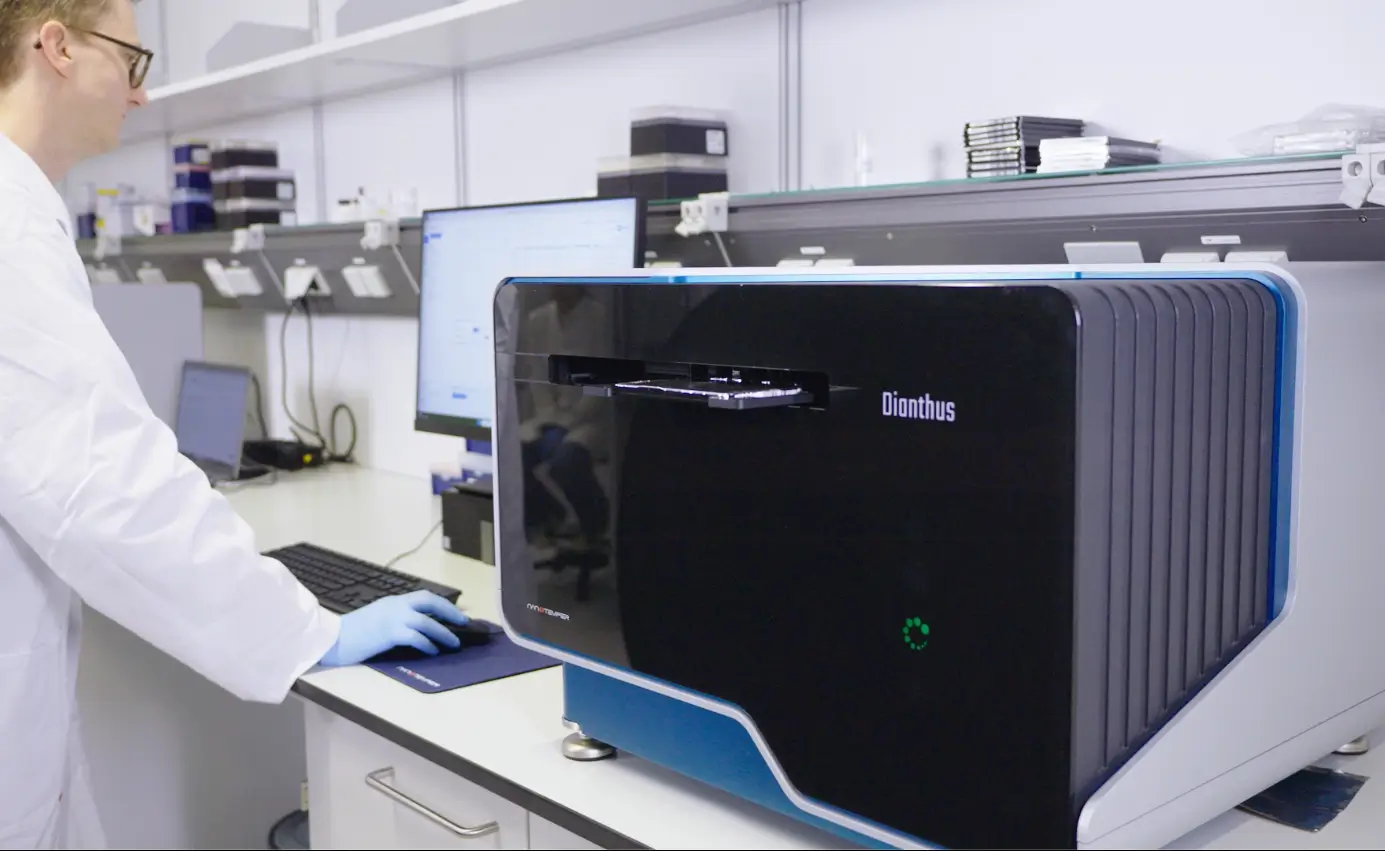
Subtle shifts.
Clear decisions.

Dianthus applications.

Get binding data across discovery, from single-point screens to full dose-response curves. In-solution measurements work across diverse targets and modalities, revealing insights that immobilization-based methods can’t provide. 

icon
Your targets.

Even the difficult ones.

Work with: intrinsically disordered proteins without stable structure, membrane proteins in detergent or lipid environments, multimeric complexes like PROTAC-induced ternary assemblies, fragments with mM-range affinity, impure protein preps with aggregates or contaminants, low-abundance targets from difficult expression systems.

icon
Hit discovery.

Screen fragment libraries and compound collections in hours, not days. Detect weak binders with mM-range affinity that other methods miss. Achieve screening quality scores (Z' > 0.8) consistently.

icon
Hit-to-lead optimization.
Generate dose-response curves for Kd or EC50 determination. Validate covalent inhibitors with direct biophysical readout. Confirm binding with ligand-induced thermal shifts.
icon
Mechanistic studies.

Run displacement assays to map binding sites. Measure ligand-induced conformational changes.
Study competitive vs. allosteric binding modes.

Two complementary technologies. One platform.  Free in solution.

Multiple insights.

image

Two complementary technologies. One platform.  Free in solution.

Multiple insights.

Spectral Shift

Dianthus detects binding by measuring spectral shifts in the emission spectrum of a fluorescently labeled target. Affinity constants are derived from changes to the fluorophore’s spectra with sub-nanometer sensitivity that catches the binders other platforms miss. Also measures protein stability through optical unfolding experiments. Compare thermal melting profiles with and without ligand to confirmation hits and gain deeper insight into binding. 


Temperature Related Intensity Change (TRIC)


Measures fluorescence changes after a brief temperature increase. Confirms hits with an orthogonal signal and reveals ligand-induced effects like aggregation behavior.

Thomas Schubert CEO at 2bind, Germany

“NanoTemper helps us turn challenging biophysical tasks into routine workflows. Their intuitive solutions give us reliable data faster, so our teams can focus on advancing drug candidates.”

Join the Newsletter

Get email updates. Your edge in biophysics. Subscribe today.

Privacy Policy(Required)

Complete your setup.

Consumables

Get reliable affinity data without worrying about sample prep. 

Dianthus 384-well plates are manufactured using the same stringent protocols used for diagnostic-grade materials to ensure the best results.  Reagent kits offer flexible labeling so you can spend less time optimizing assays and more time collecting data.

Software

Go from experiment to insight.
Without the complexity.

Getting started with affinity experiments is simple with Dianthus software. Control software is designed for easy, customizable set-up of experiments and allows you to view data acquisition in real time. Powerful Analysis software enables you to sort, highlight, and rank hits. Human and machine readable .json file formats also allow for rapid integration of instrument data into your analysis pipeline; whether it’s third party software or open source solutions. All software has a clean interface and intuitive user experience, so you’re ready to get started as soon as your Dianthus fires up.

Automation

Scale up screening.
Without the hands-on time.

For high-throughput screening screening, Dianthus is fully integratable with your existing automation solution. Use OPEN and FAIR APIs to manage your instrument and export data.

Services

Maximize instrument performance.
Without the Downtime

NanoTemper instrumentation is built to the highest standards of quality and reliability; however, it’s important to keep your instruments in good working order to ensure accurate, high-quality data output. Don’t let unexpected delays slow you down or interrupt your lab workflows. Service offerings include: relocation services, operational qualification procedures, and full coverage repair and validations.

FAQs

Dianthus

How much sample do I need per measurement?

Dianthus works with minimal sample volumes. You need as little as 10-20 μL per data point and can detect binding at target concentrations down to 250 pM. This means you can run comprehensive screening campaigns without burning through precious protein preps.

Can Dianthus integrate with my existing automation setup?

Yes. Dianthus uses standard 384-well SBS format plates and integrates with liquid handlers through the gRPC framework. The system has no fluidics, pumps, or valves to complicate automation, and plates are uniquely barcoded for tracking. You can import sample IDs directly from .xls files and export data in standard formats (.csv, .xlsx, .json) for seamless integration into enterprise workflows.

How fast can I get data?

Dianthus generates a 12-point binding curve in 1 minute. You can screen 2,000 fragments in 3 hours. The isothermal, non-destructive measurement means you can re-analyze samples if needed without starting over.

What kind of assay performance can I expect?

Dianthus consistently delivers Z' scores above 0.8, and easily above 0.5 once assay development is complete. This level of reproducibility gives you confidence in hit identification and reduces false positives in your screening campaigns.

Can I measure slow binding kinetics or covalent inhibitors?

Yes, with the Dianthus α applications package. The Slow Kinetics capability resolves binding events with measurable kinetics of kobs ≤ 1 × 10⁻² s⁻¹, letting you study covalent inhibitors and time dependent binding directly with a biophysical readout. No surface regeneration needed.